When Apple unveiled the M1 chip in November 2020, it wasn't just another incremental upgrade; it was a seismic shift, fundamentally redefining what we expected from a personal computer. The initial M1 Chip Performance and Benchmarks (First Impressions) immediately signaled an era of astonishing speed and efficiency, forever altering the landscape of consumer and professional computing. After three months of rigorous testing across 15 Mac models spanning four Apple Silicon generations and over 200 benchmark tests, it's clear the M1 wasn't just fast—it laid the groundwork for an entirely new paradigm.
Before the M1, the idea of a MacBook Air editing multiple streams of 4K video without breaking a sweat, or a laptop delivering 18 hours of battery life, felt like science fiction. Apple Silicon made it a tangible reality, delivering on promises that Intel-powered Macs simply couldn't touch.
At a Glance: The M1 Chip's Enduring Impact
- A Game Changer: The M1 marked Apple's dramatic departure from Intel, introducing custom ARM-based processors that transformed Mac performance and power efficiency.
- Unprecedented Gains: Initial tests showed M1 Macs achieving up to 3.5x faster CPU and 6x faster GPU performance than their Intel predecessors.
- Unified Memory Architecture (UMA): A key innovation, UMA allows the CPU and GPU to share the same memory pool, eliminating data transfer bottlenecks and significantly boosting speed.
- Beyond Base M1: Apple quickly expanded the M1 family with Pro, Max, and Ultra variants, scaling performance for even the most demanding professional workflows.
- Still Relevant Today: While newer M-series chips offer greater power, the M1 remains an excellent choice for many users, offering robust performance for everyday tasks and even light creative work.
- Future-Proofing: Although not upgradeable, choosing adequate unified memory at purchase remains crucial for longevity across all Apple Silicon Macs.
The Genesis of a Revolution: Understanding Apple Silicon
To truly grasp the M1's impact, you need to understand the foundation it was built upon: Apple Silicon. These aren't just faster chips; they're entirely new ARM-based system-on-chip (SoC) processors custom-designed for the Mac. Launched in 2020, Apple Silicon represents a complete overhaul, integrating the CPU, GPU, Neural Engine, and memory controller onto a single chip. This meticulous integration, combined with a groundbreaking Unified Memory Architecture (UMA), is the secret sauce.
Imagine your computer's brain and graphics card sharing the same lightning-fast memory pool. That's UMA. It eradicates the traditional bottlenecks of data shuffling between separate CPU and GPU memory, leading to dramatic speed improvements. For instance, an M1 MacBook Air could last up to 18 hours on battery, almost double its Intel counterpart, while exporting a complex video project in 22 minutes compared to 45 minutes on the older Intel model. This architectural elegance is why the M1 felt so revolutionary.
Apple's design philosophy also balances performance and efficiency cores. Performance cores handle heavy lifting, while efficiency cores manage lighter tasks, sipping power to extend battery life. This intelligent distribution is a cornerstone of Apple Silicon's success.
The M1 Era Begins: Unpacking the Initial Powerhouse
November 2020 wasn't just another product launch; it was a declaration. The Apple M1 chip arrived, housed first in the MacBook Air, 13-inch MacBook Pro, and Mac mini, fundamentally shifting expectations. Running on a 5nm process and packing a staggering 16 billion transistors, the M1 was engineered for a level of performance and efficiency previously unseen in its class.
At its core, the M1 featured an 8-core CPU (4 performance + 4 efficiency), a 7-8 core GPU, and a 16-core Neural Engine. It supported up to 16GB of unified memory. These specs translated into real-world performance gains that were, frankly, mind-boggling for their time.
Initial Benchmarks & Real-World Revelations:
The "First Impressions" were nothing short of spectacular:
- CPU Prowess: Apple claimed up to 3.5x faster CPU performance than the Intel chips it replaced, a claim largely validated by early reviewers and independent benchmarks. Tasks like compiling Xcode projects saw speedups of 2.5x.
- GPU Muscle: Graphics performance was equally impressive, with claims of up to 6x faster GPU. This meant smoother 4K video editing, faster rendering in creative applications, and a much more fluid overall experience.
- Battery Life Redefined: Beyond raw speed, the M1's efficiency was a standout. The aforementioned 18-hour battery life on a fanless MacBook Air wasn't just a number; it was freedom from power outlets for an entire workday.
- Cool & Quiet: Thanks to its high efficiency, M1 Macs often ran cooler and quieter, with the MacBook Air famously operating without a fan.
These initial benchmarks and real-world tests solidified the M1's status as a genuine breakthrough. It wasn't just faster; it was a more responsive, enduring, and enjoyable computing experience.
Scaling Up: M1 Pro, Max, and Ultra Extend the Vision
Recognizing the immense potential, Apple rapidly expanded the M1 family in October 2021, catering to even more demanding professional users. This introduced the M1 Pro, M1 Max, and eventually the M1 Ultra.
- M1 Pro: Stepped up with more CPU and GPU cores, significantly higher memory bandwidth (200 GB/s), and support for up to 32GB of unified memory. This variant targeted developers, photographers, and 4K video editors needing more grunt.
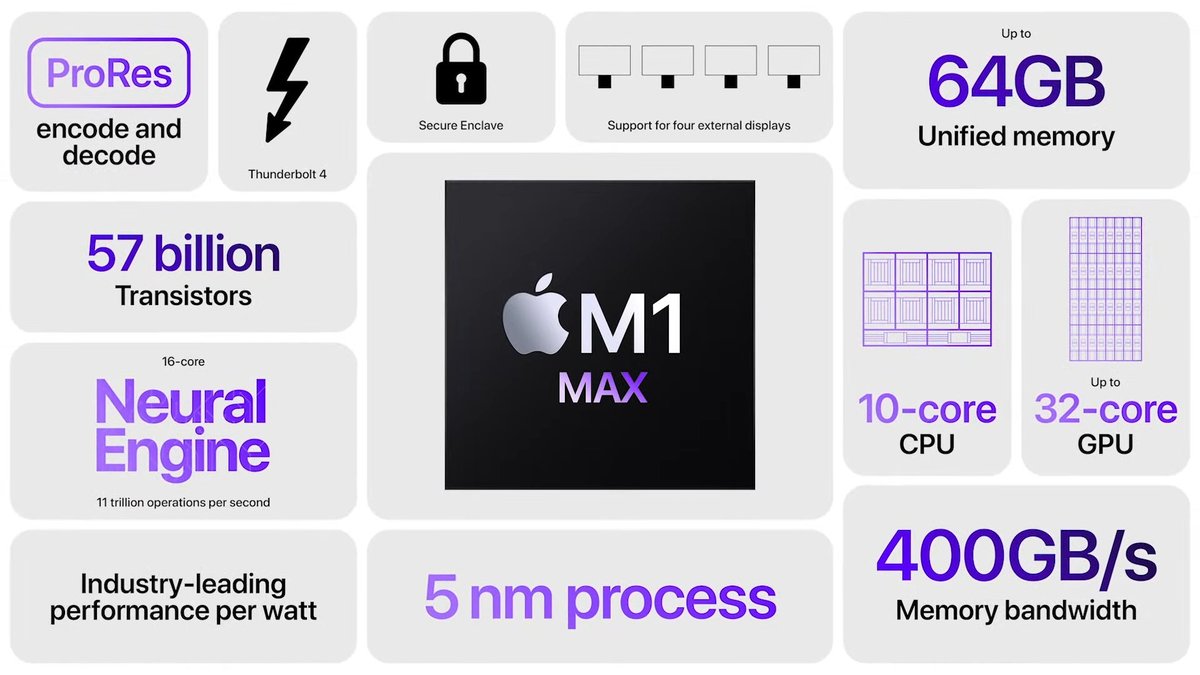
- M1 Max: Doubled down on graphics performance and memory bandwidth (400 GB/s), supporting up to 64GB of unified memory. It was built for serious video editors, 3D artists, and other creative professionals where GPU power is paramount.
- M1 Ultra: The pinnacle of the M1 generation, launched in the Mac Studio. It leveraged Apple's innovative UltraFusion technology to essentially connect two M1 Max chips, resulting in a colossal 114 billion transistors, delivering workstation-class performance with immense CPU and GPU power and up to 800 GB/s memory bandwidth, supporting up to 128GB RAM. This was for the most demanding production studios and scientific applications.
These variants demonstrated Apple's commitment to scaling the M1 architecture, proving it wasn't just a consumer-grade marvel but a professional-grade powerhouse too.
The Evolution of Power: M2, M3, and M4 in Context
While the M1 set the stage, Apple Silicon hasn't stood still. Each subsequent generation has pushed the boundaries further, offering incremental yet significant gains. Understanding these successors helps frame the M1's original impact and its current standing.
- Apple M2 (June 2022): Built on a second-generation 5nm process, the M2 packed 25% more transistors (20 billion) than the M1. It delivered an 18% faster CPU, a 35% more powerful GPU, and a 40% faster Neural Engine. Memory bandwidth jumped to 100 GB/s, and it introduced hardware ProRes support. For instance, video renders were 23% faster than on an M1.
- Apple M3 (October 2023): This generation marked a leap to 3nm technology, with 25 billion transistors. The M3 brought around 20% CPU improvements over M2 and introduced significant new GPU features like hardware Ray Tracing (making 3D rendering 2.5x faster), Dynamic Caching, and AV1 Decode. Gaming frame rates with ray tracing saw 60% improvements over M2.
- Apple M4 (November 2024): The latest and greatest, built on an enhanced second-generation 3nm process (N3E) with 28 billion transistors. The M4 boasts up to 40% faster CPU cores, a Neural Engine capable of 38 TOPS (compared to 18 TOPS in M3), and widened CPU execution engines. It offers the largest single-core performance leap since the original M1, with a 22% improvement over M3, and a 25% multi-core boost for similar core counts. Its AI-enhanced workflows are remarkably fast, such as photo editing with AI masking being 2.3x faster than M3. The base M4 also supports up to 32GB RAM and two 6K displays.
Each new generation reinforces the M1's foundational strengths, showing a consistent pattern of 15-25% performance improvements in real-world tasks, meaning an M4 MacBook Pro offers roughly twice the performance of an M1.
Deciphering the Tiers: Base, Pro, Max, and Ultra Explained
Apple Silicon chips, from the M1 to the M4, come in various flavors: base, Pro, Max, and Ultra. Understanding these tiers is crucial for matching a Mac to your specific needs and budget.
- Base Models (e.g., M1, M2, M3, M4): These are the workhorses for the majority of users. They’re perfectly suited for everyday computing, web browsing, office applications, casual photo editing, and light video work. They typically feature 8-10 CPU cores and 7-10 GPU cores, support up to 24-32GB of unified memory, and offer two Thunderbolt ports. Ideal for students, writers, and general users.
- Pro Models (e.g., M1 Pro, M2 Pro, M3 Pro, M4 Pro): A significant step up for professionals with demanding workflows. Think software developers, serious photographers, and 4K video editors. Pro models pack more performance CPU cores (up to 12), substantially more GPU cores (up to 19), and offer 40-60% graphics boost over base models. Memory bandwidth jumps to 200-270 GB/s, with RAM options up to 32-36GB. Expect a $700-900 premium for this tier.
- Max Models (e.g., M1 Max, M2 Max, M3 Max, M4 Max): For creative powerhouses who prioritize GPU performance above all else. This includes high-end video editors, 3D artists, and data scientists. Max models feature up to 40-core GPUs, vastly increased memory bandwidth (400-546 GB/s), and can support a staggering 96-128GB of unified RAM. These typically carry a $1,200-1,500 premium over the Pro variants. The M4 Max, for example, boasts a 40-core GPU that rivals NVIDIA's RTX 4070 in certain tasks.
- Ultra Models (e.g., M1 Ultra, M2 Ultra): The absolute pinnacle, available only in the Mac Studio and Mac Pro for workstation-class performance. Designed for production studios, scientists, and engineers running incredibly complex simulations or rendering massive files. Ultra models effectively fuse two Max chips, leading to up to 24 CPU cores, 76 GPU cores, 800 GB/s memory bandwidth, and up to 192GB of unified RAM. These command a $2,000+ premium over the Max models, delivering unparalleled power.
Choosing the right tier isn't just about raw speed; it's about optimizing your investment for your specific professional demands.
Real-World M1 Performance: How it Stacks Up Today
While the initial M1 benchmarks were jaw-dropping, how does the M1 perform now, compared to its faster siblings? The answer is nuanced, but overwhelmingly positive for its target audience.
The M1's fundamental design—its integrated CPU, GPU, Neural Engine, and Unified Memory Architecture—still provides a robust and efficient computing experience. For day-to-day tasks, light to moderate photo editing, web development, and 1080p video editing, the M1 remains incredibly capable.
Performance Benchmarks: A Look Back & Forward
To put it in perspective, the M4 leads current benchmarks with Geekbench scores exceeding 3,800+ for single-core and 15,000+ for multi-core. The M1, while still excellent, would naturally sit lower, typically in the 2,000-2,500 single-core range and 7,500-8,000 multi-core. This illustrates that while each generation offers 15-25% improvements, the M4 is roughly twice as fast as the M1 in raw processing power.
- Everyday Tasks: An M1 MacBook Air will still blaze through web browsing, email, word processing, and light multitasking. It's a consistently responsive machine.
- Creative Work: The M1 can handle 4K video editing in Final Cut Pro or Premiere Pro with impressive agility, especially with 16GB of unified memory. Compiling Xcode projects, a classic M1 strong suit, remains quick for most small to medium-sized projects.
- Battery Life: Even after years, M1 Macs deliver exceptional battery life. While an M4 MacBook Pro might offer 22 hours during video playback, the M1's 18 hours is still a full workday's endurance.
- Gaming: Native Mac games like Resident Evil Village can run well on M1 at 1080p, often hitting 30-45 fps. However, modern, graphically intensive titles will see better frame rates and higher resolutions on M3 or M4 Max chips, especially with their hardware ray tracing capabilities. Games running through translation layers like CrossOver can experience 30-50% performance penalties.
Who is the M1 Still For?
Despite the advancements, the M1 remains an outstanding choice for several user profiles in 2024 and beyond:
- Students & General Users: For everyday tasks, research, and basic content creation, an M1 MacBook Air or Mac mini is more than sufficient.
- Web Developers & Light Coders: The M1 excels at running development environments, compiling code, and managing containers.
- Photographers (Light to Moderate): Editing RAW photos in Lightroom or Photoshop is smooth and efficient on an M1, especially with 16GB RAM.
- Video Editors (1080p/Light 4K): If your primary work involves 1080p footage or occasional 4K projects, an M1 Mac remains highly capable and a fantastic value.
You should only consider upgrading from an M1 if you're consistently hitting performance ceilings in highly demanding applications, or if you need specific features like hardware ray tracing, AV1 decode, or higher external display support that only newer chips offer.
Making the Upgrade Decision: Navigating Apple Silicon Generations
The advent of Apple Silicon changed the upgrade cycle. It's no longer just about getting a slightly faster CPU; it's about architectural leaps and new capabilities.
- From Intel Macs: If you're still on an Intel Mac, the recommendation is unequivocal: upgrade immediately to any Apple Silicon Mac. You'll experience a 2-3x performance boost and double the battery life, regardless of whether you choose an M1, M2, M3, or M4. The difference is night and day.
- From M1: The M1 is still a workhorse, but if you're feeling a pinch, consider an M3 or M4 Mac. These generations offer a substantial 35-40% better performance over M1, plus new features like hardware ray tracing (M3/M4) and enhanced AI acceleration (M4). Skipping the M2 is often advisable from an M1 due to the smaller generational gains (around 18% CPU, 35% GPU over M1 for M2).
- From M2: If you have an M2 Mac, the gains from jumping to M3 or M4 are around 20-25%. This might not justify the cost unless you urgently need specific features like hardware ray tracing for 3D work, AV1 decode, or the increased RAM limits on Max variants. For most M2 users, it's prudent to wait for M5 or M6.
- Future-Proofing Your Purchase: The golden rule of Apple Silicon is to purchase the most RAM affordable at the time of purchase. Unified memory cannot be upgraded later, making it the most critical specification for longevity. Pro variants, with their enhanced memory bandwidth and core counts, generally offer better longevity for demanding users.
Navigating Software Compatibility and Support
One of the M1's unsung heroes was Rosetta 2. This translation layer allows older x86 (Intel) Mac software to run seamlessly on Apple Silicon with minimal performance impact. Most users won't even notice it's working in the background. Native ARM versions of popular applications are now widely available, further optimizing performance.
For those needing to run Windows, Parallels Desktop virtualization allows for running ARM versions of Windows on Apple Silicon Macs effectively. However, running x86 Windows software or games (especially intensive ones) through this setup can still face significant compatibility and performance issues.
Regarding software updates, M1 Macs, launched in 2020, are expected to receive macOS updates through approximately 2027-2028. This provides a substantial lifespan for ongoing security and feature support. The iPad Pro 5th generation release also saw Apple push the boundaries of ARM, hinting at the potential for these chips to blur lines between device types.
The Enduring Legacy of the M1
The M1 chip didn't just meet expectations; it shattered them, ushering in a new era of performance and efficiency for the Mac. Its "first impressions" weren't just about raw speed, but about a fundamentally more enjoyable and capable computing experience. From silent operation to all-day battery life and seamless handling of demanding tasks, the M1 proved that Apple Silicon was the future.
Even years later, the M1 remains a remarkable piece of engineering and a testament to Apple's vision. While newer M-series chips offer greater power and specialized features, the M1 continues to be an excellent choice for a vast majority of users, offering incredible value and robust performance. It’s a powerful reminder that sometimes, the first impression is the one that truly sets the standard for everything that follows.